
A quiet grandstand is hard to hide on camera. So is a crowd that looks disconnected, queues too long for a drink, or has no reason to stay once the final siren sounds. Stadium fan experience trends are moving well beyond the scoreboard because clubs, venues and event organisers know atmosphere now has a commercial job to do. It needs to lift player energy, give supporters a reason to return and put partners in front of a crowd that is genuinely engaged.
For Australian clubs and event teams, the strongest ideas are not always the most expensive. A major stadium can invest in screens, apps and premium hospitality. A local footy club, school carnival or regional event can create a huge lift with smarter timing, a visible crowd plan and simple merchandise that gives every supporter permission to make some noise.
Stadium Fan Experience Trends Changing Game Day
Participation is replacing passive viewing
Fans do not want to be treated like a backdrop for the action. They want a role in it. That means pre-game call-and-response moments, supporter bays, team walkouts, halftime challenges and clear prompts that tell the crowd when to stand, clap, chant or celebrate.
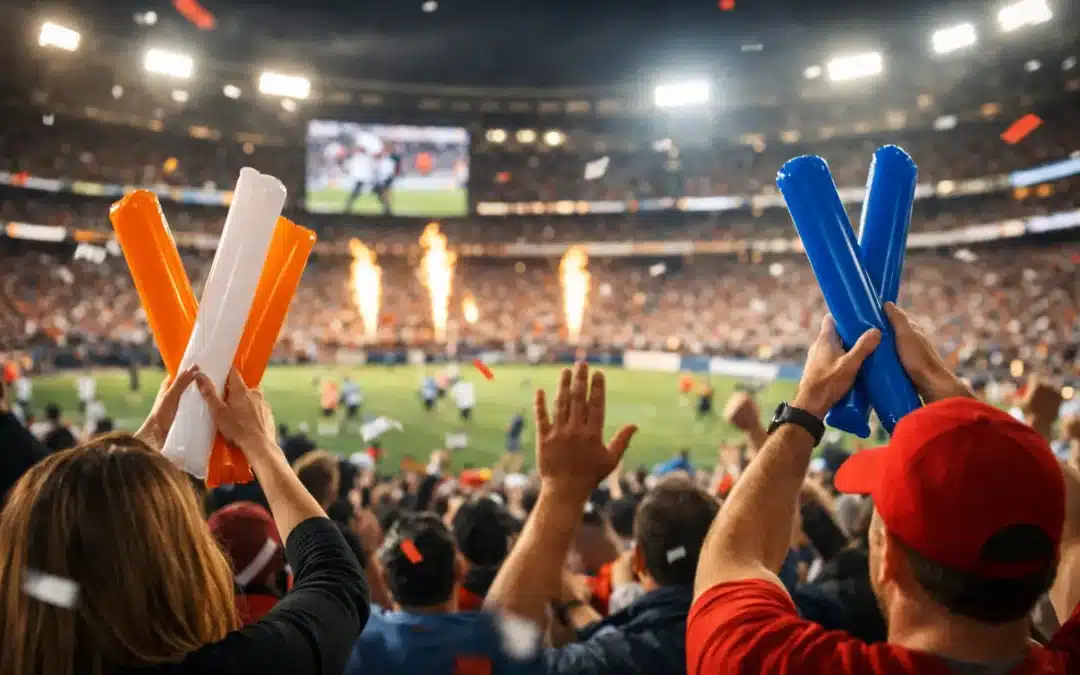
The key is making participation easy. A complicated app mechanic may suit a big-ticket venue with a highly digital audience, but it can fall flat when mobile reception is patchy or families are trying to manage kids, food and seats. Physical crowd activations still work because there is no download, login or learning curve. Hand someone a pair of branded inflatable cheering sticks at the gate and they know exactly what to do when the home side scores.
This is where visual unity matters as much as volume. Thousands of supporters holding the same club colours create a moment that looks powerful from the stands, on broadcast footage and in social posts. For sponsors, it is valuable exposure that does not feel like a static sign bolted to a fence.
The event begins before kick-off
The modern game-day experience starts in the car park, at the train station or in the queue outside the gates. Supporters increasingly judge an event on the full outing: how welcome they feel, whether there is something happening before play begins and whether arriving early feels worthwhile.
Clubs are responding with fan zones, junior activities, player appearances, music, photo opportunities and merchandise giveaways. These are not fillers. They create a reason to arrive earlier, which can ease entry congestion and increase food, beverage and merchandise spend.
A smart giveaway can also provide the thread that ties those activities together. Match-day cheering sticks in team colours might be collected at entry, used in a pre-game noise challenge, featured in a sponsor photo wall and raised again during the final-minute push. One affordable item gets repeated use across the event instead of disappearing into a showbag at the end.
Personalisation has to feel useful
Fans expect more choice, but that does not mean every activation needs to be individually customised. The useful version of personalisation is recognising different supporters and giving each group a clear way to take part. Families may value a kids’ giveaway and an early activity area. Dedicated members may respond to a supporter-bay exclusive. Corporate guests may appreciate a polished branded item that remains appropriate after the match.
For organisers, this can mean selecting different printed designs for separate grandstands, membership tiers or sponsor zones. It may be a club crest on one side and a campaign message on the other. It may be metallic finishes for a finals match, LED cheering sticks for an evening fixture, or custom shapes that connect directly to the sport, such as cricket bats or rugby balls.
More options are not automatically better. Too many versions add ordering complexity and can dilute the campaign. Start with the crowd segment you most need to energise, then choose a design and quantity that will be highly visible in that area.
Why Crowd Noise Is Back on the Agenda
For all the attention paid to digital engagement, the sound of a live crowd remains one of sport’s biggest advantages over watching from the lounge room. Noise adds tension, celebration and a shared sense of occasion. It is also contagious. Once one section starts clapping and banging, nearby supporters tend to join in.
That is why clubs are bringing back simple noise-makers and rally moments, especially for finals, rivalry rounds, junior presentations and community days. Inflatable cheering sticks are light, easy to distribute and reusable. They can be printed with team, sponsor or campaign artwork, giving organisers a practical promotional product rather than a disposable piece of signage.
The trade-off is coordination. If cheering sticks are handed out halfway through a match with no announcement, many will stay under seats. Build a moment around them. Put them on seats before gates open, distribute them at entry with a short message, and cue the crowd on the big screen or through the announcer. A 20-second noise challenge before the team runs out can turn stock into spectacle.
Cheering Sticks helps Australian clubs and event organisers create these high-impact crowd moments with custom colours, print finishes, low-minimum stock options and fast local service.
Technology Should Remove Friction, Not Replace Atmosphere
Cashless payments, digital tickets, mobile ordering and venue apps have changed what fans expect. Used well, these tools reduce queues and give people more time watching the match. Used badly, they create another barrier between the supporter and the event.
The best technology stays in the background. Clear digital wayfinding can stop people wandering for food outlets. Mobile ordering can make sense at a packed stadium, but a small club may get a better result from extra service points and visible signage. A QR competition can capture leads for a sponsor, yet it needs a worthwhile prize and a quick entry process.
Do not make the phone the only route to engagement. A supporter who has run out of battery, has limited data or simply wants to watch the game should still be able to participate. The strongest fan experiences layer digital convenience over real-world energy: music, colour, movement, noise and a crowd reacting together.
Sponsors Need a Role, Not Just a Logo
Sponsors are asking tougher questions about event spend. A logo on a screen has value, but it is much easier to measure and renew when the sponsor is attached to a moment supporters remember.
Think of a local business presenting the loudest bay competition, a major partner funding a free supporter giveaway or a campaign sponsor putting a message on a reusable pair of cheering sticks. The sponsor becomes part of the action, not an interruption to it. The brand is seen in photographs, carried through the stands and associated with positive crowd energy.
Keep the branding balanced. Fans are there for their club, school or event first. Put the team identity front and centre, then give the sponsor a clear but complementary position. A design overloaded with logos rarely becomes a keepsake and is less likely to be raised when the big moment arrives.
Measure the moments that matter
Attendance is only one measure of a better fan experience. Track early arrivals, member renewals, repeat attendance, merchandise take-up, competition entries, sponsor leads and social content created on the day. Ask gate staff and volunteers what people responded to. They will often spot practical issues that a dashboard misses.
For a physical activation, count what was distributed and where. If one supporter bay produced the best noise and visual impact, repeat the approach there at the next fixture. If a giveaway ran out before a key arrival period, adjust the distribution point or quantity. Small refinements can make a modest budget work much harder.
Build the Right Experience for Your Crowd
There is no single stadium formula. A professional venue chasing membership growth will plan differently from a grassroots club hosting its annual presentation day. The audience, weather, match time, budget, venue rules and distribution crew all matter.
Start with one question: what do you want supporters to do? Arrive early, make noise, share a photo, visit a sponsor zone, stay after the game or come back next round? Once that action is clear, choose an activation that makes it simple and enjoyable.
The best game-day ideas do not ask fans to work hard. Give them something worth waving, a moment worth joining and a reason to feel part of the home crowd. When the whole stand responds at once, that is the experience people remember long after the score is forgotten.