
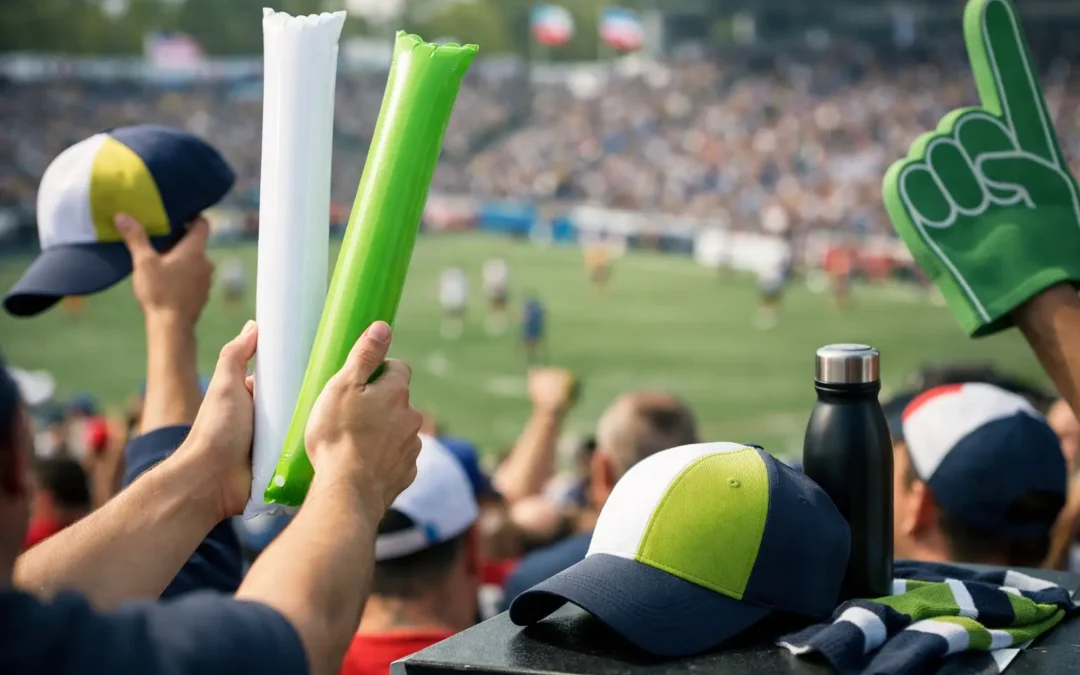
A quiet crowd can flatten even the best fixture. When the stands look flat and sound flat, sponsors get less exposure, teams get less lift and the whole event feels smaller than it should. That is why branded merchandise for sporting events matters – not as an afterthought, but as part of the event plan from day one.
For clubs, schools, marketers and event organisers, the right merchandise does two jobs at once. It builds atmosphere in the moment and keeps your branding visible before, during and after the event. Done well, it is practical, affordable and easy to hand out. Done badly, it ends up in a box under the trestle table or in the rubbish before full time.
What good sporting event merchandise actually needs to do
Not every promo product works in a live event setting. A sporting crowd is busy, loud and moving. People are arriving at different times, sitting in different areas and paying attention to the action, not carefully unwrapping something delicate or complicated.
That means the best merchandise is simple to use, instantly recognisable and visible from a distance. It also needs to suit the event format. A school athletics carnival has different needs from a televised rugby clash, a local footy fundraiser or a sponsor-driven corporate sports day.
In practical terms, good event merchandise usually needs at least three strengths. It should be easy to distribute fast, it should carry your branding clearly, and it should add something to the atmosphere. If it can create movement, colour or noise, even better.
This is where many buyers make the right call by choosing products designed for crowd response rather than generic giveaway stock. Pens and keyrings still have their place, but they do not change the feel of a grandstand. Inflatable cheering sticks, clap banners, LED cheering items and custom-shaped supporters’ products do.
Why branded merchandise for sporting events delivers better value
The real value is not only in the unit price. It is in what the product does once it is in people’s hands.
When merchandise gets used during the event, every photo becomes more branded. Every crowd shot looks stronger. Every sponsor logo in the stands gets more visibility. For clubs and schools, that can help justify sponsorship packages. For event organisers, it improves presentation and spectator involvement. For campaign teams and promotional marketers, it creates instant visual impact without the cost of large-scale fixed signage.
There is also a multiplier effect. A product that fans wave, bang together or carry through the gate becomes part of the experience. People remember the atmosphere, and they remember who put the branding in front of them. That is a much stronger result than a passive item that disappears into a bag.
Of course, not every event needs the loudest option available. Some indoor events, premium corporate settings or mixed-use venues may need a more controlled merchandise choice. That is where it pays to match the item to the audience rather than assuming one product fits every crowd.
The products that work hardest at sporting events
If the goal is energy, visibility and practical value, cheering products are hard to beat. Inflatable cheering sticks are one of the strongest options because they are lightweight, affordable and highly visible across a venue. They are also easy to customise with team colours, sponsor logos, event names or campaign messages.
They work especially well for footy, cricket, basketball, netball and school carnivals because they create movement and noise without needing much explanation. Hand them out at the gate and people know exactly what to do with them.
Custom shapes can take that impact further. A cricket bat shape fits junior and club cricket promotions. Rugby ball or paw shapes can align with mascots, school houses or team identities. Metallic finishes and LED options can suit night games, finals, fan activations and festival-style events where you want the crowd to stand out on camera.
Stock products also have a place. If timing is tight or the budget is lean, ready-to-go cheering items with low minimums can still deliver a strong result. The trade-off is usually less branding flexibility, but for many community clubs and smaller events, speed and simplicity matter more.
How to choose branded merchandise for sporting events
The best buying decisions usually start with four practical questions: who is the crowd, what is the venue, how fast do you need it, and what do you need the item to achieve?
If your event is about fan participation, noisy products make sense. If the goal is sponsor exposure, prioritise print area and colour visibility. If children are a big part of the audience, choose items that are safe, lightweight and easy to carry. If your event runs across multiple games or locations, think about storage and transport as well.
Budget matters, but so does usage. A cheaper product that nobody uses is not cheaper in any meaningful sense. A slightly higher-value item that appears in every team photo and across the whole crowd often delivers a better return.
Turnaround is another factor buyers should not leave until late. Custom merchandise takes planning, especially if artwork approvals, colour matching or event logistics involve multiple stakeholders. Fast service helps, but the strongest results still come when organisers allow enough time for proper proofs, print decisions and delivery scheduling.
Custom branding options that make a difference
Branding is not just about adding a logo and hoping for the best. At sporting events, legibility and contrast matter more than tiny details. Your artwork needs to read from a distance and make sense in motion.
Bold colours, clear text and simple messaging usually perform best. Team names, sponsor marks, short taglines and event branding all work well when the layout is clean. If you try to fit too much onto a product, the impact drops fast.
This is also where local support matters. A supplier that understands event merchandise can guide you on print areas, colour combinations and product finishes that actually work in the field, rather than just on a screen. Free digital proofs, quick revisions and practical advice can save a lot of last-minute headaches.
For Australian buyers, local service can also make communication easier when deadlines are tight. You want answers quickly, not a delayed email chain when bump-in day is approaching.
Where buyers get it wrong
One common mistake is choosing merchandise too late and being forced into whatever is available, rather than what suits the event. Another is focusing only on unit cost without considering distribution, visibility or crowd use.
Some organisers also underestimate how much branding can be lost through poor artwork choices. Light text on a light background, crowded layouts or logos placed too small will not do the job in a live venue.
Then there is the mismatch problem. A premium sponsor event may not suit the same item as a grassroots finals day. A silent indoor awards function is not the place for high-noise products, but an outdoor sporting crowd absolutely can be. Context matters.
That is why event-specific merchandise usually performs better than generic promotional stock. It is designed around what the crowd is actually doing, not just what fits in a carton.
A smarter way to plan your order
The best approach is to treat merchandise as part of your event operations, not just your marketing spend. Think about when it will be handed out, who will distribute it and where it will be most visible. Entry points, supporter bays, student sections and sponsor activation zones all create different opportunities.
It also helps to decide early whether your priority is atmosphere, fundraising, brand exposure or a mix of all three. That makes the product choice much clearer. Some clubs want reusable supporter gear they can bring out every season. Others need a single-event hit of colour and noise. Both are valid, but they lead to different buying decisions.
For organisations that want practical advice and quick turnaround, working with a specialist supplier such as Cheering Sticks can take a lot of pressure off the process. When the product range is built around sporting events and crowd engagement, it is easier to get the right item without wasting time.
The strongest sporting events feel bigger than the headcount. They sound better, look sharper and give supporters something to rally around. If your merchandise can help create that effect while putting your branding front and centre, it is doing exactly what it should.